
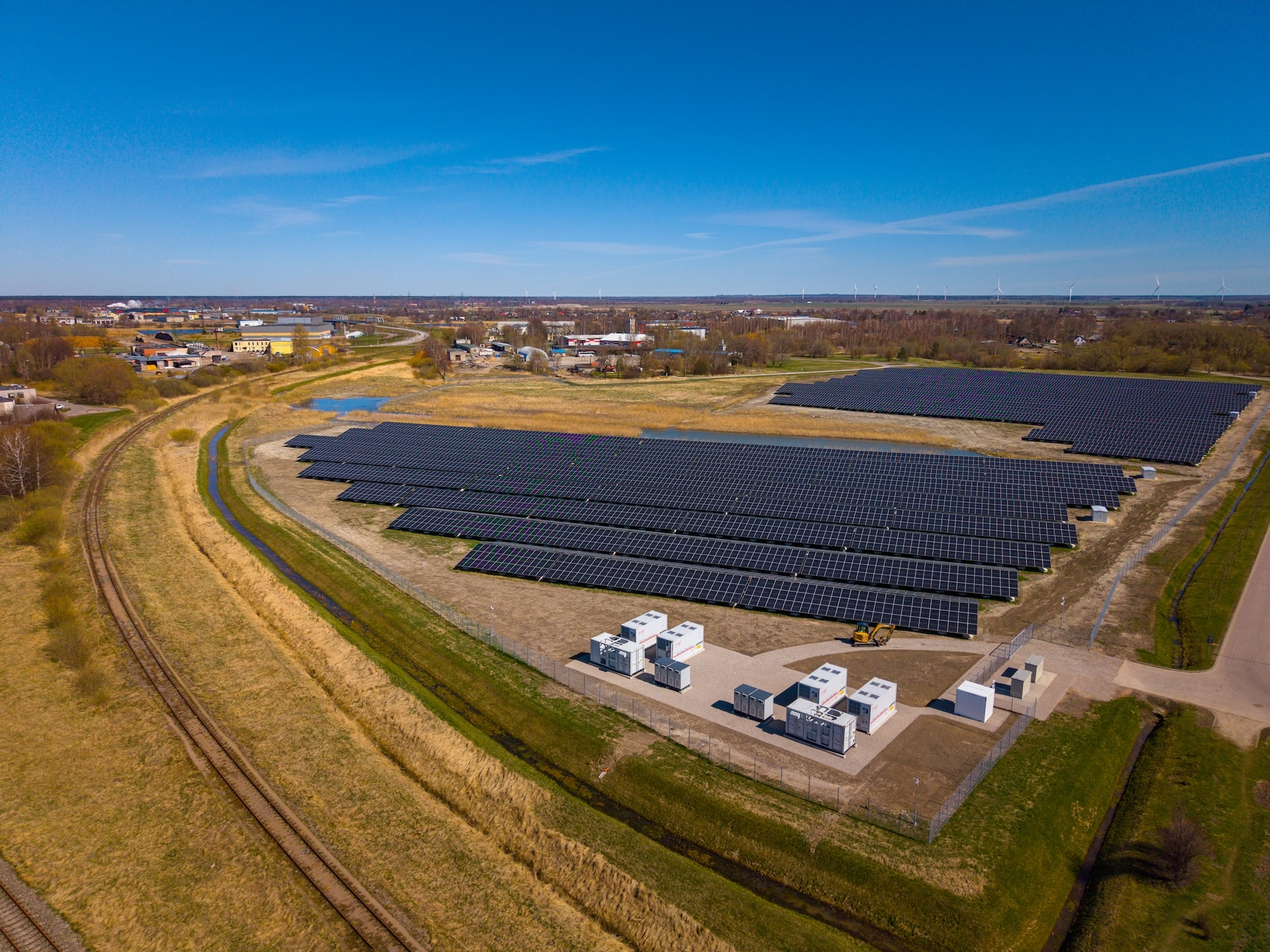
For investors looking at the Baltics today, the real question is not whether standalone BESS or co-located BESS is “better” in absolute terms. The better question is: better for which phase of the market? Right now, standalone batteries have a very strong case. They are the purest way to capture the value of volatility, ancillary services, and merchant flexibility in a market that is still early and undersupplied. But that is only part of the story. As the market matures and more batteries enter the system, co-located battery projects are likely to show increasing strength because they solve a different problem: they do not just monetize volatility, they also protect renewable economics.
Why standalone BESS looks so strong right now
In the Baltics, the short-term case for standalone BESS is unusually powerful because the market has changed fast. The region synchronized with Continental Europe in February 2025, and the Baltic balancing capacity market launched at the same time. In Latvia, AST then joined the PICASSO platform in April 2025, opening a broader aFRR market environment for fast, flexible assets. Those are exactly the conditions in which standalone batteries tend to shine: they are not tied to a single generation profile, they can chase whichever revenue stream is strongest, and they can move between balancing, capacity reservation, intraday, and arbitrage strategies with much more freedom than a battery linked to a renewable plant.
That flexibility has mattered because the Baltic market has been exceptionally volatile in its first phase. Clean Horizon’s Baltic storage analysis says ancillary-service capacity reservation prices in the Baltics have averaged roughly 2 to 8 times Finnish levels since market opening, with mFRR prices hitting the €4,000/MW/h cap several times in 2025. That is why the Baltics moved onto the radar of battery investors so quickly. These are not mature-market conditions. They are early-cycle conditions, where scarcity and volatility reward fast-response storage disproportionately.
Latvia is especially interesting within that story because the commercial BESS fleet is still comparatively thin. AST’s balancing market launch materials said total Baltic balancing-capacity demand would be around 1,500 MW in 2025, with demand expected to rise further as renewables and prosumer generation increase. That creates exactly the kind of timing advantage standalone investors look for: strong revenue signals, functioning markets, and relatively limited commercial battery competition.
Why hybrid projects become stronger as markets mature
But that does not mean standalone BESS will always be the better bet. In fact, the medium- to long-term case may tilt toward hybrid projects, especially solar-plus-storage.
The reason is simple: as more batteries enter a market, ancillary-service revenues usually compress. Clean Horizon’s Finland analysis provides a useful European example. It says that high BESS penetration on aFRR and mFRR capacity markets in Finland is already pushing reservation prices down, with revenue shifting progressively toward day-ahead, intraday, and energy trading rather than pure reserve markets. That is a familiar pattern in battery markets: early entrants benefit from scarcity in ancillary services; later entrants need a broader, more resilient revenue stack.
That is where co-located projects begin to show their strength. A hybrid BESS does more than earn ancillary revenues. It can also protect the economics of the renewable plant it sits next to. This matters because Europe is already dealing with solar cannibalization and more frequent negative or very low prices during renewable-heavy hours. As solar penetration rises, captured solar prices deteriorate most visibly during daylight hours, undermining pure-merchant PV economics. In that environment, a battery next to the generation asset becomes a commercial hedge, not just a flexibility asset.
The Baltic case for hybrid is getting stronger
This is particularly relevant in Latvia and the Baltics because renewable build-out is accelerating quickly. AST reported that Latvia’s solar generation rose 70% year on year to 678 GWh in 2025. AST has also said it has signed more than 2 GW of renewable connection agreements, including around 1,600 MW of solar, of which about 600 MW is expected to be paired with BESS, and around 600 MW of wind, about 60 MW of which is also expected to include BESS. Those are not marginal numbers. They indicate that the market is already moving toward hybrids as a structural part of the next buildout wave.
And there are practical reasons for that shift beyond revenues. One of the most obvious benefits of co-location is that the renewable asset and the battery can share a grid connection. In markets facing long connection queues, that can help projects come to market faster and reduce the CAPEX associated with installing storage. Co-located BESS also becomes increasingly valuable when it can reduce a renewable developer’s exposure to negative-price periods, a market dynamic becoming more relevant across Europe.
So which investment is better?
In the Baltics today, standalone BESS probably has the stronger short-term merchant case. If the goal is to capture the upside of a newly opened, volatile balancing market with relatively low commercial saturation, standalone batteries are hard to beat. They are simpler to optimize for market participation, freer to stack revenues, and best positioned to exploit the exceptional early-market price signals that have appeared since synchronization.
But hybrid BESS may offer the stronger medium- to long-term investment logic. As ancillary-service revenues normalize and renewable penetration rises, the value of protecting capture prices, shifting output into better hours, sharing interconnection infrastructure, and improving project bankability becomes more important. In that world, the battery is no longer just a merchant trader. It becomes an integral part of making renewable generation more resilient and more financeable.
The real answer, then, is not “standalone or hybrid.” It is standalone first, hybrid for durability.
The takeaway for investors
For investors in Latvia and the wider Baltics, that is the key takeaway. Standalone BESS is one of the most attractive flexibility assets in the region right now because the markets are new, volatile, and still undersupplied. But as the region’s solar and wind fleet scales, and as ancillary-service markets become more competitive, hybrid parks are likely to show why they are such powerful long-term assets. They do not depend on one single revenue story. They combine flexibility with generation, and that combination tends to get stronger as the power system gets more renewable and more complex.