
Latvia is no longer a side story
For international investors looking at battery energy storage systems, Latvia is emerging as one of Europe’s most attractive near-term BESS markets. Since the Baltics synchronised with Continental Europe, the region has become far more dynamic, but Latvia stands out because it combines a rising need for flexibility with lower merchant BESS saturation than its Baltic peers.
That combination is important. The best BESS markets are usually not the largest or most mature. They are the ones where monetisation is already visible, but the field is not yet crowded. Latvia increasingly fits that description. It already has the market architecture, volatility, and renewable build-out that support storage revenues, while the commercial battery fleet remains comparatively thin.
Clean Horizon’s Baltic market update described ancillary-service prices in the Baltics as “soaring” after market opening, with average ancillary-service capacity reservation prices running roughly 2 to 8 times above Finland. Its 2025 Baltic storage analysis indicates battery revenue levels far above those seen in more mature European storage markets, underlining how exceptional the current Baltic window remains. That is exactly the kind of setup that attracts serious investor attention.
BRELL disconnection changed the economics of flexibility
The real inflection point was the Baltic states’ disconnection from the BRELL system and synchronisation with Continental Europe in February 2025. That event was geopolitical, but also deeply commercial. ENTSO-E confirmed the successful synchronisation on 9 February 2025, while the Baltic balancing capacity market went live on 4 February 2025. For the first time, the Baltics began procuring balancing capacity through a common regional framework built for a European market environment rather than for legacy dependence on Russia-controlled frequency management.
Latvia moved further in April 2025, when AST joined the PICASSO platform and expanded the operational market for automatic frequency restoration reserves. In practical terms, that significantly increased the relevance of fast, flexible assets. Batteries are almost purpose-built for that environment. They react faster than conventional generation, can move across several value streams, and are well suited to products such as FCR, aFRR, mFRR, intraday optimisation, and arbitrage around increasingly volatile renewable output.
In other words, Latvia did not simply “become more interesting” after synchronisation. It became structurally better for storage. The market now has a clearer need for rapid-response flexibility, more formal balancing frameworks, and stronger monetisation pathways for exactly the type of asset BESS investors want to build.
Price signals are strong enough to make Europe pay attention
One reason Latvia deserves to be described as one of Europe’s hottest BESS markets is that the price environment has been unusually strong by continental standards. The Nord Pool / Clean Horizon Storage Index now tracks storage revenues across European bidding zones, including Latvia, and its Baltic commentary highlights exactly how exceptional the region has looked in the first phase of market opening.
According to Clean Horizon, ancillary-service prices in the Baltics have repeatedly reached extreme levels since market opening, with mFRR hitting the €4,000/MW/h cap on several occasions. The same analysis states that Baltic ancillary-service capacity reservation prices have averaged multiple times Finnish levels. For investors used to more mature markets such as Germany, Great Britain, or even Finland, that matters because it shows that the Baltics are still in the premium phase of the storage opportunity curve rather than the compression phase.
AST’s own market materials point in the same direction. The Baltic balancing market launched with expected total regional balancing-capacity demand of around 1,500 MW in 2025, and AST has explained that demand should keep rising as renewable generation and the number of generating consumers increase. In a market where flexibility demand is rising faster than merchant battery penetration, batteries are not marginal assets. They are scarce assets.
That does not mean today’s revenue spikes should be projected forever. They should not. But it does mean that Latvia currently offers the kind of early-cycle price environment that investors typically look for before a market becomes crowded and ancillary revenues normalise.
Latvia is the least saturated BESS market among the Baltics
This is the key Baltic comparison, and it is the strongest part of the Latvia investment case.
Lithuania moved earlier and at bigger scale on storage. Energy Cells operates four battery parks with total capacity of 200 MW / 200 MWh to support system security and synchronisation. Estonia has also moved earlier on commercial-scale batteries, with Eesti Energia commissioning a 26.5 MW / 53.1 MWh system at Auvere in 2025 and additional large projects progressing behind it. Latvia, by contrast, only opened its first utility-scale commercial battery in late 2024: Utilitas Wind’s 10 MW / 20 MWh project in Targale.
Yes, Latvia now also has AST’s 80 MW / 160 MWh batteries in Rēzekne and Tume. But those assets should be understood correctly. They are synchronisation and system-security infrastructure, not evidence that Latvia’s merchant market is already crowded. They improve system readiness and market functionality, but they do not invalidate the core commercial point: among the three Baltic states, Latvia still looks the least saturated on the merchant BESS side.
That distinction is important. Investors are not only asking how many batteries exist in a country. They are asking how crowded the competitive revenue environment already is. Lithuania is further along. Estonia has moved earlier. Latvia still looks like the market where the structural need is real, the rules are working, but the merchant field remains relatively open. That is why Latvia can credibly be described as the least saturated BESS market in the Baltics today from a commercial-investor perspective.
Renewables are scaling fast — and that makes storage more valuable, not less
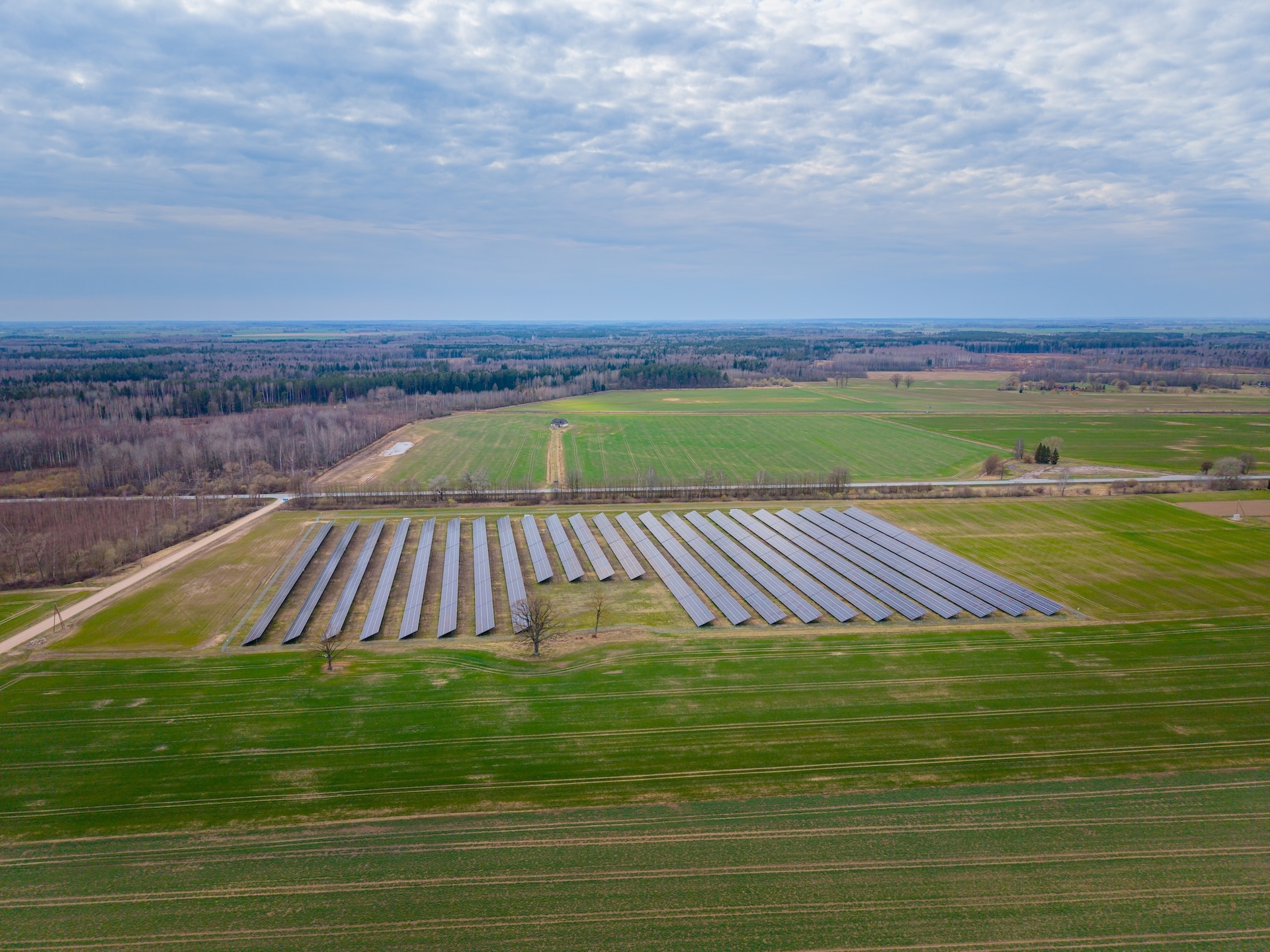
The second major pillar of the Latvia thesis is renewable growth. AST’s annual electricity market review for 2025 shows that solar generation in Latvia rose by 70% year on year to 678 GWh. That is not a niche trend. It is evidence that the country is moving rapidly into a more variable generation mix, with all the consequences that follow: deeper intraday swings, sharper imbalance risk, midday oversupply episodes, and stronger need for fast-responding flexibility.
The development pipeline points in the same direction. AST has reported signed connection agreements exceeding 2 GW, including around 1,600 MW of solar, of which about 600 MW is expected to be paired with BESS, and around 600 MW of wind, of which about 60 MW is also expected to be complemented by BESS. That does not mean every megawatt will be built on schedule, but it does show that the market direction is clear: much more variable generation is coming.
And here is where the BESS case becomes especially attractive. In pure solar markets, growing PV penetration can pressure capture prices. In storage-linked markets, the same build-out improves the strategic value of batteries. More solar and wind means more balancing demand, more intraday volatility, and more hours when flexibility earns a premium. Batteries can monetise exactly the instability that a rapidly growing renewable fleet introduces.
Latvia is therefore attractive not despite renewable growth, but because of it. The faster wind and solar are added, the stronger the long-term case for storage becomes.
Latvia is still behind its neighbours in renewable scale — which improves the timing for BESS
There is another reason the Latvia window looks so compelling: the country is still less developed in variable renewables than its Baltic neighbours, which leaves more room for storage-led value creation as the market catches up.
At the beginning of 2025, Estonia already had 1,210 MW of solar connected to its electricity system, according to Elering. Lithuania is even further ahead: Litgrid reported that the country reached 6 GW of wind and solar capacity connected to transmission and distribution networks by early 2026. Latvia’s market is accelerating fast, but it is still earlier in the cycle than either Lithuania or Estonia in several important segments.
That combination is highly attractive for battery investors. Latvia is no longer too early — the market signals are already visible — but it is not yet late. There is enough renewable growth to create volatility, enough balancing need to support strong price formation, and still enough white space on the merchant BESS side to preserve upside for early movers. In many European markets, investors arrive after the crowd. In Latvia, the crowd is only beginning to form.
The takeaway for foreign investors
The Latvia story is not that the market will stay extraordinary forever. It will not. More storage will be built. More capital will enter. Ancillary-service pricing will eventually compress, just as it has in every market that matures.
The real opportunity is that Latvia is still in the part of the cycle where first-mover economics can be unusually attractive. It has a post-BRELL balancing architecture, access to wider European platforms, strong volatility, rapidly increasing renewable penetration, and the least saturated merchant BESS environment in the Baltics. That is a powerful combination.
For foreign investors looking for where battery storage is genuinely hot in Europe right now, Latvia belongs very near the top of the shortlist. Not because it is the biggest market. Because it may be one of the best-timed ones.
Public sources linked for fact checking
ENTSO-E confirmation of Baltic synchronisation with Continental Europe (9 Feb 2025)
AST: Baltic balancing capacity market launch
AST: PICASSO / aFRR market integration
AST: balancing and ancillary services overview
Nord Pool / Clean Horizon Storage Index overview
Clean Horizon: Baltics added to Storage Index; Baltic ancillary-service prices vs Finland
AST electricity market review 2025
AST: connection agreements and hybrid pipeline
Utilitas: Latvia’s first utility-scale commercial BESS
AST: Rēzekne and Tume battery systems
Elering: electricity consumption and generation in Estonia
Litgrid 2025 results / Lithuanian renewable and storage build-out
Litgrid / Renewables Now: Lithuania reaches 6 GW of wind and solar capacity